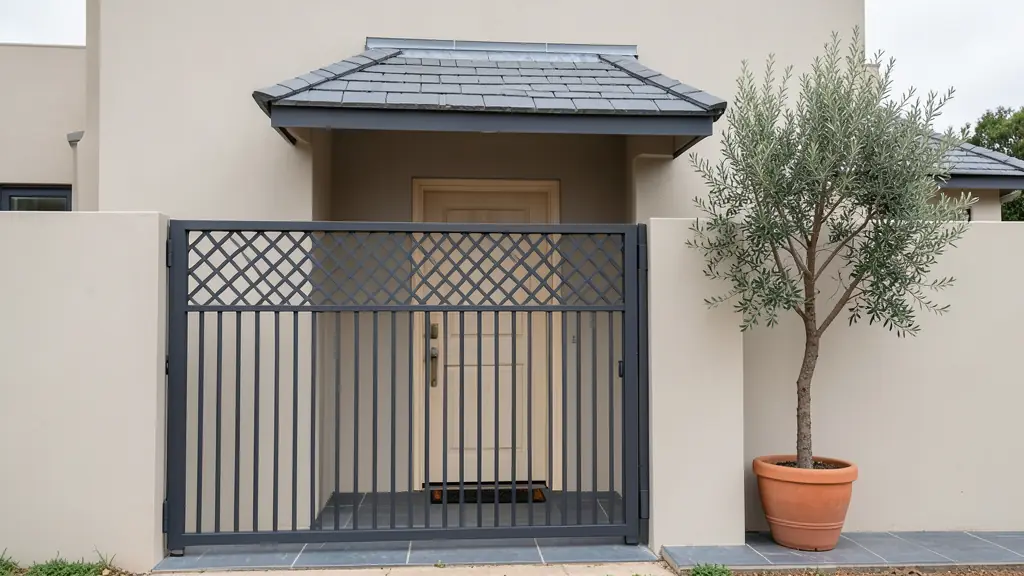
Most fitting problems with security gates start with one measurement taken in one place. Brick openings are rarely square, so a gate made to the width at the top may not fit at the bottom. Measure like an installer and you can order the right size, compare quotes properly and spot an opening that needs work first.
How to measure the opening
- Width: measure across the opening at the top, the middle and the bottom, brick to brick (or frame to frame).
- Height: measure from the finished floor or sill to the top at the left and right.
- Diagonals (optional): measure corner to corner both ways. If they differ by more than about 10 mm, the opening is out of square.
- Reveal depth: from the face of the wall back to the door frame, and how far the door handle sticks out.
Use a steel tape, write every figure in millimetres and note which way the door opens.
Inside the reveal or on the face of the wall
Inside the reveal looks neat and is harder to pry, but the gate must be made to the smallest width and height less a fitting gap, and the reveal must be deep enough for the gate and the door handle. Face fixed gates are bolted to the outside wall and overlap the opening by 40 to 50 mm all round, which hides an uneven opening and suits shallow reveals and patio sliders. Fitting onto an existing door frame is common on flats and townhouses with steel frames.
Leaves, stacking and sliding
Hinged gates over about 1,100 mm wide are usually made as two leaves so they don't sag and don't swing into the room. Trellis doors and expanding gates fold to one or both sides, and the folded stack takes roughly 15 to 20 percent of the width, which narrows the walkway. Sliding gates for patio doors run on a track and need a clear wall or fixed panel the width of the leaf to slide over.
Frequently asked questions
Do I measure the door or the opening?
How much gap is left around a gate in a reveal?
My measurements differ by 15 mm. What now?
Should I measure myself before asking for quotes?
More free tools
- Security door cost calculatorA rough price for doors, gates and bars from your own sizes, with the extras that change it.
- Burglar bar cost calculatorPrice every window in the house by room, in steel, aluminium-friendly, clear or decorative bars.
- Burglar bar spacing calculatorHow many bars a window needs, the real gap between them, and the steel length and weight.
- Which security door or gate?Four questions about your opening, your household and your budget, and the type that suits it.
- Quote comparison toolPut up to three quotes side by side and see what each one leaves out before you choose.